
Portable message boards (PCMS) and arrow boards: When and how to use them
Clear communication is essential in any work zone. Using the wrong traffic control device can confuse drivers, cause delays, and create unnecessary risks for your crew.
Portable changeable message signs (PCMS) and arrow boards are two common tools for managing traffic around a work zone. While both help drivers navigate changing road conditions, they serve different purposes and need to be used and positioned correctly.
This guide covers when to use a PCMS versus an arrow board, what each device is designed to do, and how to position them for maximum visibility and a safer driver response.
What is a portable changeable message sign (PCMS)?
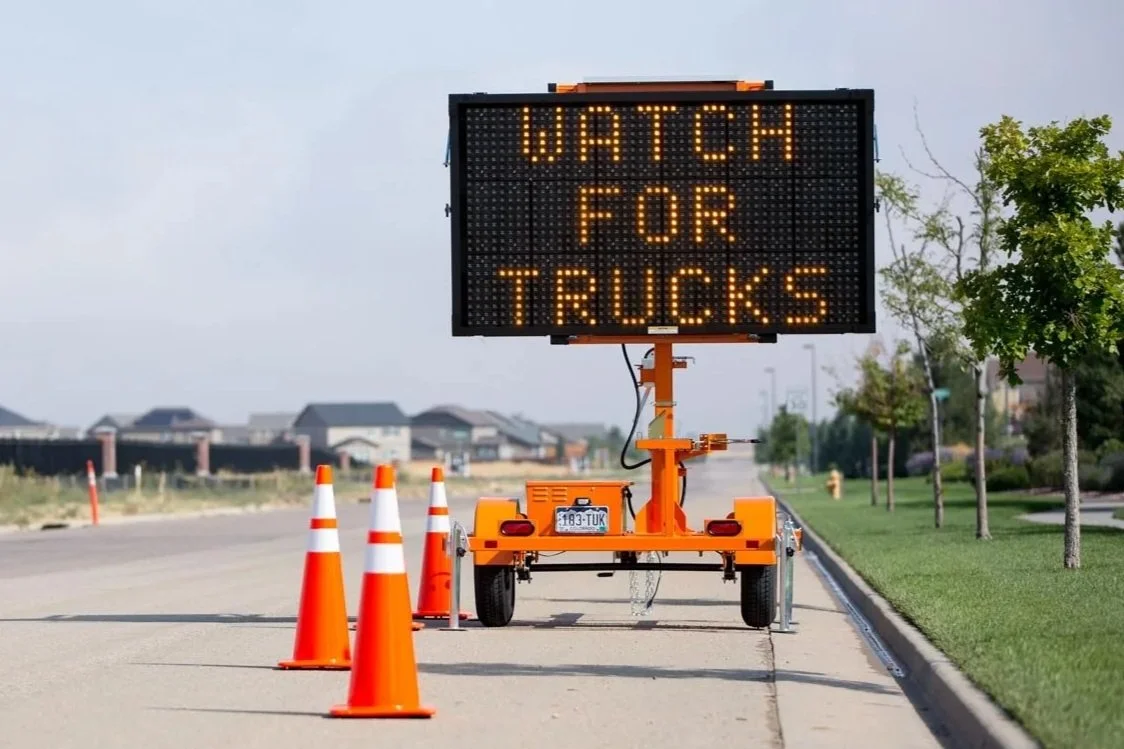
A PCMS is a trailer-mounted electronic sign that displays text messages to drivers. It can be programmed to show warnings, instructions, or updates about conditions ahead.
Unlike a static sign, a PCMS can be updated as conditions change. This makes it useful for communicating lane closures, detours, delays, alternate routes, and other temporary traffic conditions.
Under MUTCD guidance, PCMS messages should be short and easy to understand. Messages should typically use no more than two display phases, with each phase shown for at least 2 seconds and the combined display time limited to 8 seconds. This gives drivers enough time to read the message and respond appropriately.
What is an arrow board?
An arrow board is a trailer- or vehicle-mounted panel that uses illuminated arrows or chevrons to direct traffic. Unlike a PCMS, it does not display text. Its purpose is to give drivers clear directional guidance.
Arrow boards for traffic control are classified into several types, with Types A, B, and C commonly used for work-zone applications. Each type is suited to different roadway conditions and uses.
Type A: Typically used on lower-speed urban streets.
Type B: Used on intermediate-speed roads and mobile operations on highways.
Type C: Designed for high-speed, high-volume roads where the display must be visible from farther away.
Arrow boards are mounted on non-reflective black panels, and MUTCD guidance specifies minimum mounting-height requirements to help keep the display visible to approaching drivers.
PCMS vs. arrow boards: What is the difference?
| Feature | PCMS | Arrow Board |
|---|---|---|
| Displays | Text messages | Directional arrows or chevrons |
| Best for | Warnings, instructions, changing conditions | Directing traffic during lane closures and merges |
| Typical use | Advance warning, detours, event notices | Active lane closures, shoulder work, mobile operations |
| Visibility standard | Must be readable to approaching drivers in daylight conditions | Distance depends on board type (A, B, or C) |
| Message limit | Two phases, 8 seconds per cycle | Not applicable, arrows only |
When should you use a PCMS?
A portable message board for traffic control is useful when drivers need information that a single static sign can't communicate as effectively.
Common uses include:
Lane closures and detours: Give drivers advance notice of a closure and explain upcoming route changes.
Advance warning of road work: Let drivers know about work ahead so they can prepare for delays or choose another route.
Speed reduction zones: Reinforce a temporary speed limit before drivers enter the affected area.
Events or incidents: Update drivers as traffic conditions change during an event, crash, or other temporary situation.
Night work: Warn drivers before they reach an active nighttime work zone.
When are arrow boards used?
Arrow boards are most useful when drivers need a clear visual warning or directional guidance during a temporary traffic control operation.
Common applications include:
Lane closures that require merging: Arrow or chevron displays show drivers which direction to merge on a multilane roadway.
Shoulder work: An arrow board can provide extra warning for work on or near the shoulder. In this situation, the board is generally used in caution mode.
Mobile lane closures: During work that moves along the roadway, an arrow board alerts approaching drivers and directs them to merge.
High-speed or high-volume roads: Arrow boards provide a highly visible indication of a lane closure, helping drivers recognize the need to merge well in advance.
Can PCMS and arrow boards be used together?
PCMS and arrow boards can be used together when the traffic control plan and roadway conditions require both information and directional guidance.
For example, a PCMS may be placed in advance of a lane closure to warn drivers about what is ahead. Closer to the closure, an arrow board can show drivers which direction to merge while signs and channelizing devices guide them through the work zone.
Not every operation requires both devices. The appropriate setup depends on factors such as roadway speed, traffic volume, work activity, sight distance, and the requirements of your traffic control plan.
How to position PCMS and arrow boards correctly
Placement matters as much as the device itself.
Give drivers enough time to respond
Position devices where approaching drivers have enough time to see, understand, and react to the information. Consider roadway speed, sight distance, traffic conditions, and the work zone layout.
Maintain clear visibility
Avoid locations where curves, hills, vehicles, equipment, or other obstructions could block a driver's view of the device.
Consider the clear zone and roadside conditions
PCMS units should be positioned outside the clear zone where practicable. If a device must be placed closer to traffic, follow the applicable requirements for delineation and protection.
Place arrow boards near the taper
For a stationary lane closure, the arrow board should generally be placed on the shoulder at the beginning of the merging taper. If the shoulder is too narrow, the board may be placed in the closed lane.
Keep PCMS messages brief
Drivers have only a few seconds to read a message while approaching a work zone. Use brief, familiar wording and include only the information they need to respond safely.
Common mistakes when using PCMS and arrow boards
Putting too much text on a PCMS: Long messages are harder to read at roadway speeds. Keep the wording short and direct.
Using the wrong arrow board type: Types A, B, and C are designed for different roadway and traffic conditions. Choose a board that fits the application.
Placing devices too close to the work zone: Drivers need enough distance to read the message, slow down, or merge safely.
Using an arrow board for a lane shift: Arrow boards are for lane closures, not for guiding traffic when an open lane simply shifts around a work area.
Using the wrong display mode: For example, during shoulder work, use caution mode rather than an arrow or chevron display.
Skipping equipment checks: Damaged components or failed display elements can make a device harder to see and less effective.
Getting the right equipment for your job
The equipment you need depends on the roadway, traffic volume, speed, project duration, and type of work being performed.
Right Traffic offers a range of traffic control products, including portable message boards and both portable and truck-mounted arrow boards. For temporary projects, traffic control sign rental options are also available.
If you are planning a project, contact Right Traffic to discuss the equipment and traffic control setup that best fits your job.
Frequently asked questions
What is the difference between a PCMS and an arrow board?
A PCMS displays text messages about closures, detours, delays, or other temporary conditions. An arrow board uses directional or caution displays to provide additional warning and guidance during certain traffic control operations.
What are the requirements for using arrow boards in work zones?
Arrow boards must meet MUTCD requirements for factors such as size, legibility, display mode, and application. Type A, B, and C boards are intended for different roadway and traffic conditions.
How far in advance should a PCMS be placed before a work zone?
There is no single placement distance that applies to every work zone. A PCMS should be positioned to give drivers enough time to read the message and respond appropriately, taking into account roadway speed, sight distance, traffic conditions, and the required action.
Can one arrow board replace a PCMS?
Not necessarily. The two devices serve different purposes, and a project may require one, both, or neither, depending on the traffic control plan and roadway conditions.
Do PCMS and arrow boards require a permit to use?
Requirements vary by jurisdiction, roadway, and project. Check the applicable agency requirements and the approved traffic control plan before placing either device.
