
Traffic Control Compliance Requirements in Ohio Construction Work Zones
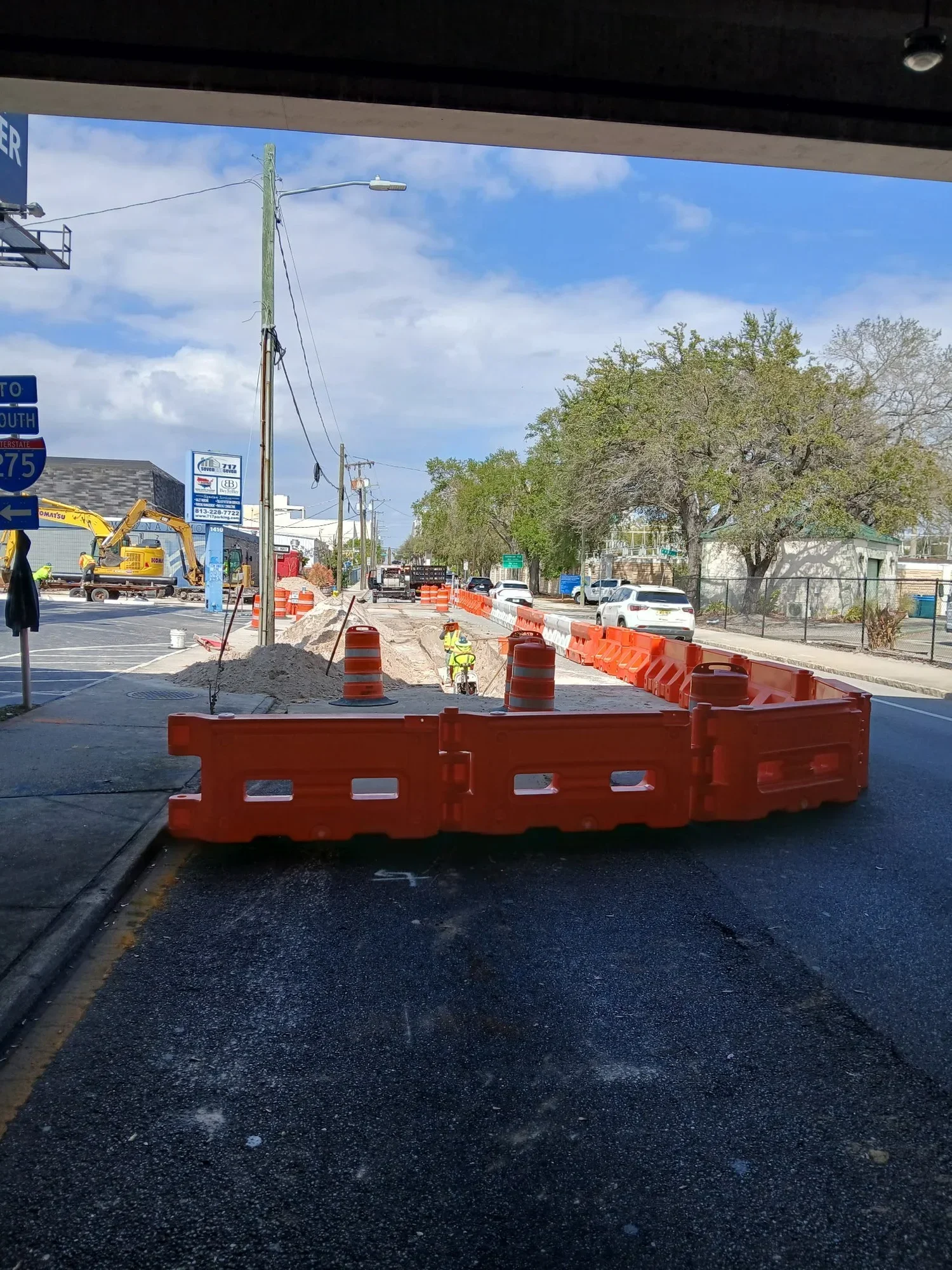
Keeping a construction work zone compliant in Ohio requires careful planning, proper setup, and ongoing attention throughout the project. Contractors must follow state standards, project-specific requirements, and approved traffic control plans while adapting to changing conditions in the field.
Getting these details right helps protect workers and road users while reducing the risk of corrective work and project delays. This guide covers the key Ohio traffic control requirements to consider before mobilization, during setup, and throughout each phase of construction.
Why work zone compliance matters in Ohio
Work zone safety continues to be a serious concern on Ohio roads. The state recorded 4,435 work zone crashes in 2025.
During the same period, troopers issued 7,019 speeding citations in Ohio work zones. More than a third involved drivers traveling at least 20 mph over the posted speed limit. Over the past five years, excessive speed was a factor in roughly 30% of deadly work zone crashes in the state.
While you cannot control how every driver behaves, you can control whether drivers receive enough warning, in the right sequence and at the right distance, to understand what is ahead and react before they reach the work area. That is what a compliant setup is designed to do.
Compliance also helps keep the project running smoothly. When a traffic control setup does not match the approved plan, it can lead to corrective work, delays, additional coordination with the agency, and unnecessary traffic disruption.
Which traffic control requirements apply to your project?
Requirements in Ohio vary depending on the roadway, the type of work, and the agency or authority with jurisdiction. There are four main sources of requirements to consider:
The OMUTCD
Ohio uses its own traffic control manual rather than relying solely on the federal MUTCD. The Ohio Manual of Uniform Traffic Control Devices sets requirements for temporary traffic control and traffic control devices across the state.
Part 6 is especially relevant to construction work. It covers areas such as device standards, taper geometry, sign spacing, flagger operations, and worker protection. These requirements apply to roads open to public travel throughout Ohio, including city streets.
ODOT requirements
If you are working on an Ohio Department of Transportation (ODOT) project, Item 614, Maintaining Traffic, of the Construction and Material Specifications applies.
Item 614 covers the contractor's responsibility for maintaining vehicular and pedestrian traffic throughout the project, including the use of signs, drums, cones, barricades, temporary pavement markings, signals, and lighting.
It also requires the travel surface to remain smooth and free of holes, ruts, ridges, and dust. Devices must meet applicable NCHRP 350 crashworthiness criteria and OMUTCD requirements, and ODOT's MT-series standard construction drawings provide approved layouts for many common situations.
Two Item 614 details are easy to overlook. Temporary pavement markings should be installed before traffic is moved into a new pattern, with no-passing zones marked within 3 days and passing zones within 14 days.
Local agency requirements
City and county projects often come with their own requirements for permits, right-of-way approvals, traffic control plan reviews, and sometimes preconstruction meetings.
Lead times can vary significantly from one jurisdiction to another, so it is worth checking early. Local requirements are often the part of the process most likely to affect your mobilization date.
Project documents
Contract documents, plan notes, and special provisions may include requirements specific to the job.
When a project-specific requirement differs from a standard drawing, the project requirement will usually govern. Reviewing those details while pricing the traffic control gives you a chance to account for them before the project is awarded.
What to address before your crew mobilizes
Traffic control should be planned around how the work will affect normal road use. Working through the following steps early gives your team a clearer picture of the equipment, personnel, and approvals the project will require.
Confirm jurisdiction and permits: Identify the agency responsible for every roadway affected by the project, and get permit lead times in writing.
Determine whether a standard layout applies: Simple lane closures and shoulder work often fit an ODOT standard drawing. Intersection work, multi-phase staging, detours, sidewalk closures, and work affecting a signalized approach are more likely to require a project-specific plan.
Allow time for plan approval: Build the review period into your schedule rather than treating it as a formality at the end.
Inventory devices against the plan: Count signs, drums, cones, barricades, and arrow boards against the approved layout, and include spares for replacement during the project.
Plan for pedestrians and bicycles: Closing a sidewalk or crossing usually means providing a defined alternate route, not simply putting up a closed sign.
Decide on a flagging method: Determine whether the work calls for flaggers, an AFAD, temporary signals, or a full detour, and confirm the project allows the method you plan to use.
Prepare the crew: Confirm flagger training, high-visibility apparel, and paddle condition before the first shift.
Map out the phase changes: Know what the setup should look like during each phase and who will be responsible for making the transition.
What a compliant Ohio work zone includes
The approved traffic control plan is the starting point. From there, the field setup has to match the plan and the applicable OMUTCD requirements.
Several details are worth paying close attention to:
Advance warning sign spacing
Spacing between advance warning signs depends on the type of road and traffic speed:
| Road Type | Spacing Between Signs | Typical Application |
|---|---|---|
| Urban, low speed | 100 ft | Local streets and downtown work |
| Urban, high speed | 350 ft | Arterials and higher-speed city routes |
| Rural | 500 ft | Two-lane county and state routes |
| Expressway or freeway | 1,000 to 2,640 ft | Interstate and limited access work |
Taper length
Merging taper length is calculated using a formula, where L is the taper length in feet, W is the offset width in feet, and S is the posted speed:
40 mph and under: L = WS² / 60
45 mph and over: L = W x S
A 12-foot lane closure at 55 mph, for example, calls for a merging taper of at least 660 feet.
Short tapers are a common field deviation, often because the setup was estimated instead of measured. Measuring the taper during setup is a simple way to avoid the issue.
Channelizing devices
Cones, drums, and barricades guide traffic through or around the work area. Once they are in place, they need to stay where the approved plan calls for them.
For nighttime work, the devices also need to be retroreflective so drivers can see them in low-light conditions.
Temporary pavement markings
ODOT evaluates work zone pavement markings against specified performance criteria. If the markings no longer meet those criteria, they must be repaired or replaced. When this happens within 120 calendar days of installation, the contractor must make the correction at no additional cost to ODOT.
Barriers where required
Barriers provide separation between traffic and the work area when project conditions or the approved plan call for additional protection. They are more likely to come into play with higher traffic speeds, longer-duration exposure, drop-offs, or work taking place close to live lanes.
Buffer space is also part of the traffic control layout, and it should not be used for equipment, vehicles, or material storage.
Pedestrian routes
When construction affects a sidewalk or crossing, pedestrians still need a clear and accessible route through or around the work area.
Temporary pedestrian routes should be usable by pedestrians with disabilities. In practice, that generally means providing a channelized path with a detectable edge rather than using cones and tape alone.
What should your flaggers know?
Flaggers directly control traffic, so their responsibilities are worth addressing before placing them in an active work zone. Under OSHA 29 CFR 1926.201, flagger signaling and the use of flaggers and warning garments must conform to Part 6 of the MUTCD.
High visibility apparel: ANSI/ISEA 107 Performance Class 2 or 3, in fluorescent orange-red, fluorescent yellow-green, or a combination, with retroreflective material visible at a minimum of 1,000 feet.
Signaling device: An octagonal STOP/SLOW paddle on a rigid handle, at least 18 inches wide, with letters at least 6 inches high. White on red for STOP, black on orange for SLOW.
Training: Flaggers should be trained in the signaling procedures covered by the manual. Ohio does not issue a statewide flagger card, but ODOT projects and many local agencies expect documented training, and some project specifications call for a specific certification.
Staffing: On ODOT projects, Item 614 calls for a minimum of two flaggers for one-way traffic operations.
Position and communication: The flagger station should be visible far enough in advance for approaching drivers to stop safely, and the flagger needs an escape path clear of the travel lane in case a driver does not respond.
When an AFAD can help
An Automated Flagger Assistance Device (AFAD) can be useful for managing alternating traffic while reducing the amount of time workers spend close to live traffic.
The Guardian SmartFlagger is designed for this type of operation and may be a good fit for longer one-lane, two-way traffic setups on lower-volume roads.
How should traffic control be checked as work progresses?
Even a work zone that is set up correctly at the beginning of the shift can change as the day goes on. Signs get blocked, devices are displaced, the work area expands, and traffic patterns change as the project progresses.
A quick, consistent inspection routine can help catch these issues before they become larger problems.
At the start of the shift
Confirm that every sign in the approved sequence is present, upright, clean, and at the correct spacing.
Walk the taper and compare the device count with the plan.
Check that temporary markings match the traffic pattern in use.
During the shift
Reset displaced devices as soon as they are noticed.
Recheck sign visibility after equipment or material deliveries.
Adjust flagger stations when the work area or traffic pattern changes.
At each phase change
Review the full setup against the approved plan for the new phase.
Remove or cover devices that no longer apply. The OMUTCD calls for temporary traffic control devices to be removed as soon as practical when they are no longer needed, and shielded or delineated when removal is not feasible.
Document the change. Timestamped photos are a simple way to keep a record of what the setup looked like at each stage.
A traffic control plan may be correct on paper, but the field setup still needs to reflect what is actually happening on the roadway. Checking the work zone as conditions change helps keep the arrangement aligned with the current phase of construction.
Common compliance issues on Ohio jobs
A few issues come up more often than others, and most are straightforward to prevent.
Tapers that are too short. This often happens when the distance is estimated instead of measured.
Signs placed wherever there is room. Sign spacing is based on road type and speed, not simply on the available shoulder.
Old signs left in place. Once the work moves, signs that no longer apply can confuse drivers and make other warnings less effective.
Sidewalk closures without an accessible alternate route. Pedestrians still need a usable way through or around the work zone.
Devices that are difficult to see at night. Nighttime work requires retroreflective devices and may call for additional lighting.
Using an old setup after the project changes phases. Every staging change is a good time to check the full layout again.
Limited documentation. Photos and simple inspection notes make it much easier to show what the work zone looked like at a given point.
What happens when a work zone is not compliant?
For contractors, a noncompliant setup can create several problems:
Corrective work to bring the traffic control back in line with the approved plan.
Direction from the engineer to stop or pause work until the setup is corrected.
Delays that affect the project schedule.
Additional exposure if a crash occurs while the field setup does not match the plan.
A more difficult relationship with the agency on future projects.
How Right Traffic can help
Right Traffic helps contractors manage work zones based on each project's needs. We design traffic control plans that account for state and local requirements, provide trained traffic control professionals, and supply the equipment and rentals needed to keep the field setup aligned with the plan.
When it makes sense for the project, Right Traffic can also deploy the Guardian SmartFlagger, an Automated Flagger Assistance Device designed to reduce worker exposure to live traffic.
Planning a construction project in Ohio? Contact your local Right Traffic team to discuss your traffic control needs before work begins.
Frequently asked questions
What is traffic control compliance in Ohio?
Traffic control compliance means setting up and maintaining a work zone in accordance with the Ohio Manual of Uniform Traffic Control Devices (OMUTCD), applicable ODOT or local agency requirements, and the project's approved traffic control plan.
Does Ohio use the federal MUTCD?
Ohio has adopted its own manual, the OMUTCD, which is based on the federal MUTCD but serves as the governing document in the state. Part 6 covers temporary traffic control. Federal OSHA regulations reference the MUTCD, and in Ohio, those requirements are addressed through the OMUTCD.
How long does a lane closure taper need to be in Ohio?
Merging taper length is calculated using L = WS² / 60 for posted speeds of 40 mph or less and L = W × S for posted speeds of 45 mph or greater, where W is the offset width in feet and S is the posted speed in mph. For example, a 12-foot closure at 55 mph requires a merging taper of at least 660 feet.
Do Ohio flaggers need to be certified?
Ohio does not issue a statewide flagger certification, but flaggers should be trained in the signaling procedures outlined in OMUTCD Part 6. ODOT projects and many local agencies expect documented training, and some project specifications may require a specific certification.
Who is responsible for maintaining traffic control on an ODOT project?
Under ODOT Item 614, the contractor furnishes, installs, and maintains traffic control facilities and devices for the duration of the project, and needs the engineer's approval before closing a lane or modifying existing devices.
How often should an Ohio work zone be checked?
At a minimum, at the start of each shift, whenever the work area or traffic pattern changes, and at every construction phase change. Devices that no longer apply should be removed or covered as soon as practical.
Can traffic control requirements vary between projects?
Yes. Requirements can differ based on the roadway, the work activity, traffic conditions, project specifications, and the agency responsible for the road. Reviewing the requirements before work begins helps you avoid relying on a setup that may not fit the new project.
